OneByte Global
2024
My Role
Lead Designer - UI/UX Design Interaction Design, Prototyping.
Team
Me as Designer, Satyam as product manager and Amit as front end developer
Timeline
May 2024 - Aug 2024
Overview
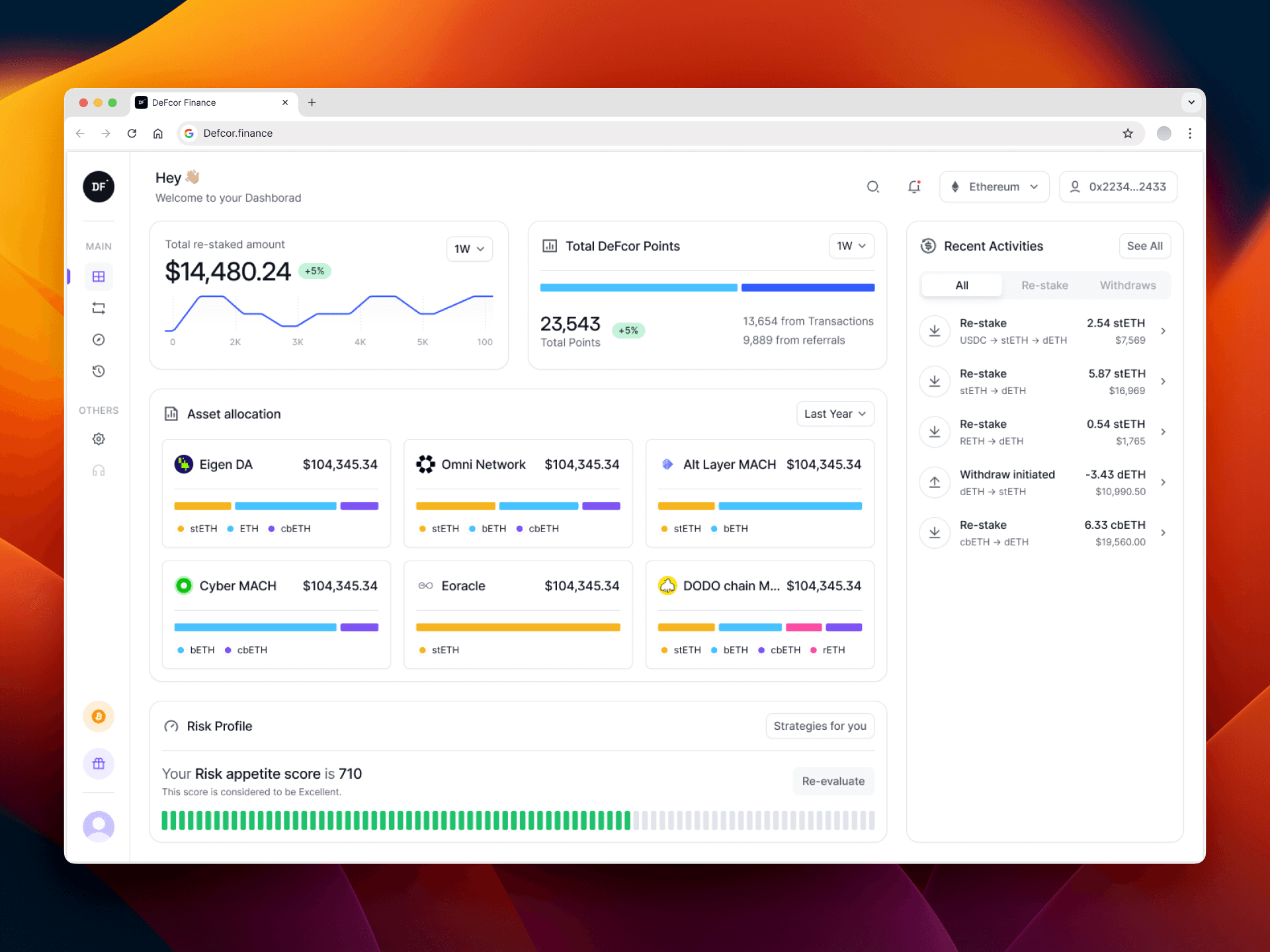
DeFcor is a modular restaking platform designed to give restakers more control, better risk visibility, and access to a wider range of strategies.
I led the end-to-end product design—from architecture to UI system—focusing on clarity, trust, and decision-making for users navigating the complex world of Liquid Restaking Tokens (LRTs).
What Exactly Was the Problem? |
As the restaking ecosystem evolved, most Liquid Restaking Token (LRT) platforms followed a one-size-fits-all approach, limiting restakers to preset strategies with little transparency or choice. These platforms acted as centralized risk and asset managers—selecting which AVSs (Actively Validated Services) to support, often behind closed doors.
We identified four key gaps:
No control or choice in restaking
users can’t choose AVSs or manage their allocation preferences.
No visibility into risk
platforms don’t surface AVS reliability, validator stats, or slashing data.
Fragile, all-or-nothing token design
one bad AVS can break the LRT, and there’s no way to rebalance.
Complex UX that deters users
core actions are buried under unclear flows, poor labeling, and data overload.
Together, these issues made restaking feel inaccessible and untrustworthy—especially for institutions or serious users.
User & Market Understanding
We started by looking at the current landscape of Liquid Restaking protocols—platforms like EigenLayer, Karak, and BounceBit. While they succeeded in abstracting the technical complexity of restaking, they also introduced new issues:
No user agency: Users couldn’t choose which AVSs they restaked into—platforms made that decision behind the scenes.
Opaque AVS logic: There was little to no visibility into what made an AVS risky or reliable.
Institutional mismatch: Larger, risk-aware users—like DAOs, treasuries, or institutional players—had no tooling for control, risk toggling, or custom strategies.
Who We Were Designing For ?



Most platforms were optimizing for onboarding simplicity—but at the cost of control, trust, and risk clarity, Our product had to reverse that.
Give users control over how they restake, let them see the logic behind the strategies, and make sure the interface supports confidence, not confusion.
Information Architecture & Flow Design
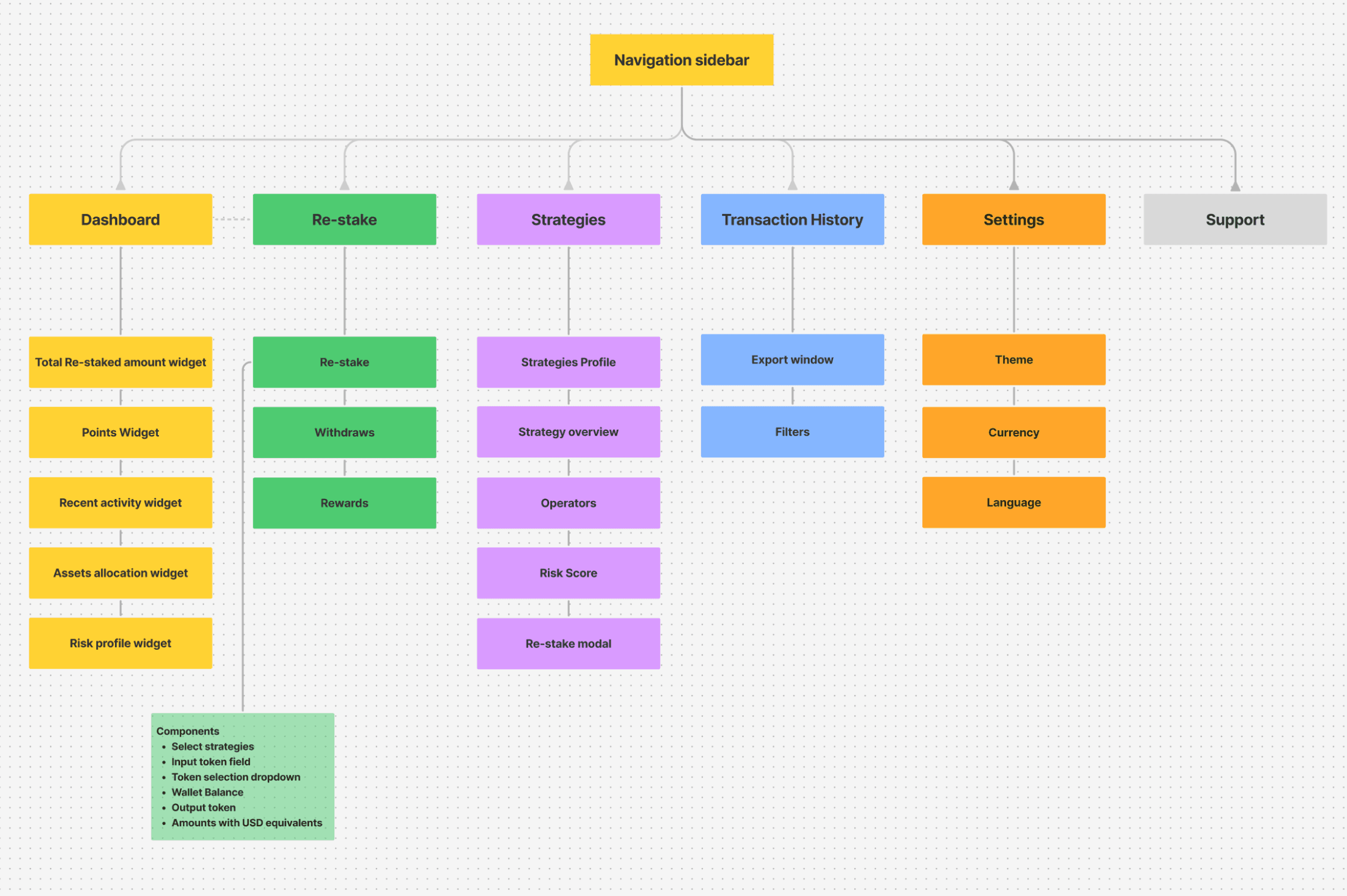
Restaking is complex by nature—multiple assets, multiple strategies, live performance metrics, and risk variables. We needed an interface that could organize this chaos without overwhelming the user.
Key Design Goals
Clarity over depth: Let users explore more only when they need to.
Modular from the start: AVS pools, strategies, and assets needed to be treated as flexible building blocks.
Two-sided UX: Support both casual users who want a quick restake, and power users who want to compare, customize, and dig deeper.
Behind the Scenes: Flows & PRDs
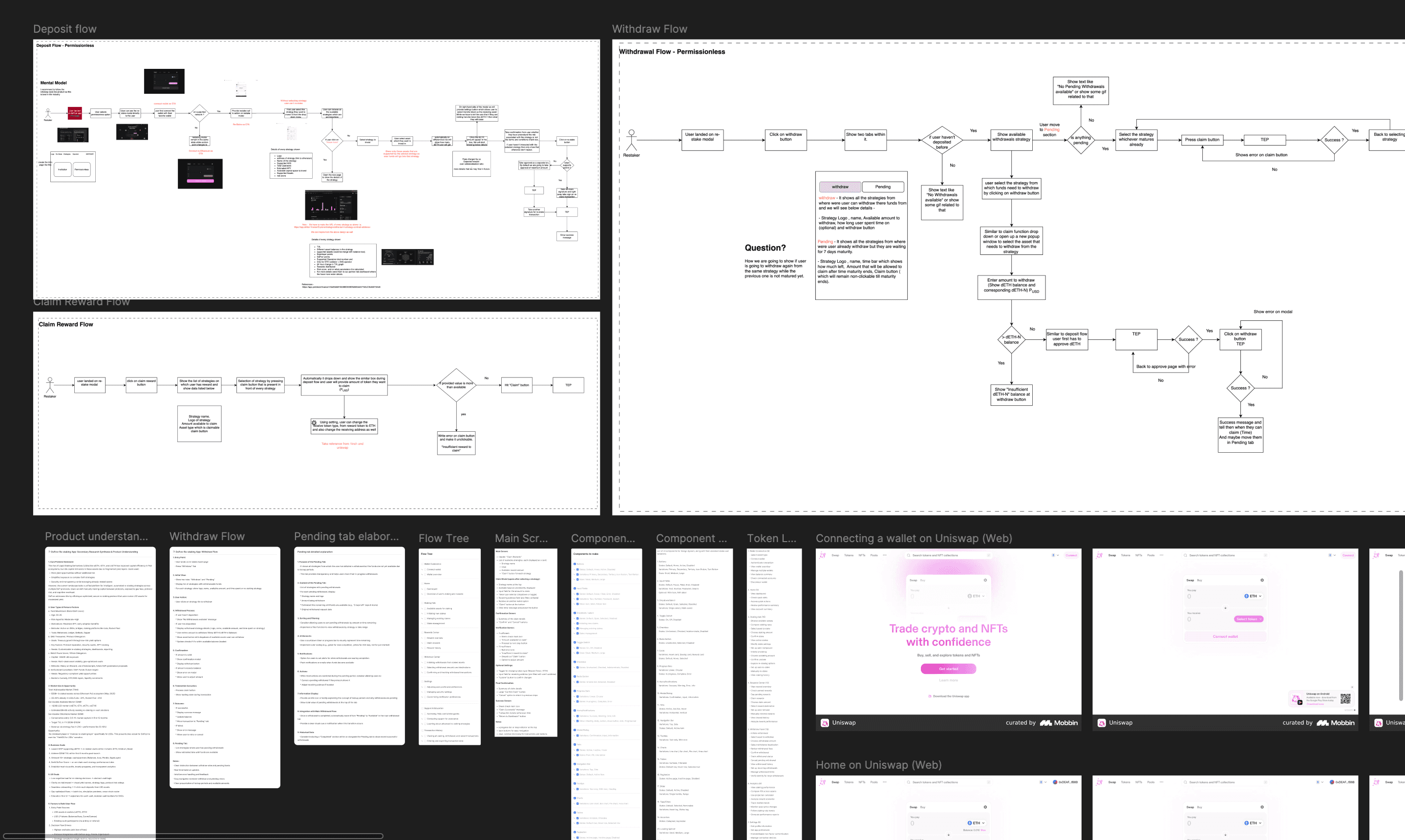
Before jumping into wireframes or UI, I worked closely with the team to map out core flows like Deposit, Withdraw, and Reward Claiming. Every edge case, modal state, and failure path was covered to reduce ambiguity during handoff.
These flowcharts and PRDs helped:
Align stakeholders on expected behaviors
Prioritize what needed design clarity (e.g. pending states, slashing alerts)
Build a modular, scalable system that worked for both permissioned and permissionless strategies
This early investment in flow logic and product clarity saved countless hours during UI design and dev implementation.
Design Execution
Navigation: Built for Clarity, Not Complexity
Most DeFi platforms overwhelm users with hidden menus, jargon, and deep nesting. For DeFcor, we built a clean, persistent sidebar that puts essential actions front and center—while still being flexible enough to scale.
Why it matters
Users aren’t lost, they know exactly where they are and what they can do next—even on complex flows like strategy comparison or token restaking.
Dashboard: From Black Box to Clear Snapshot
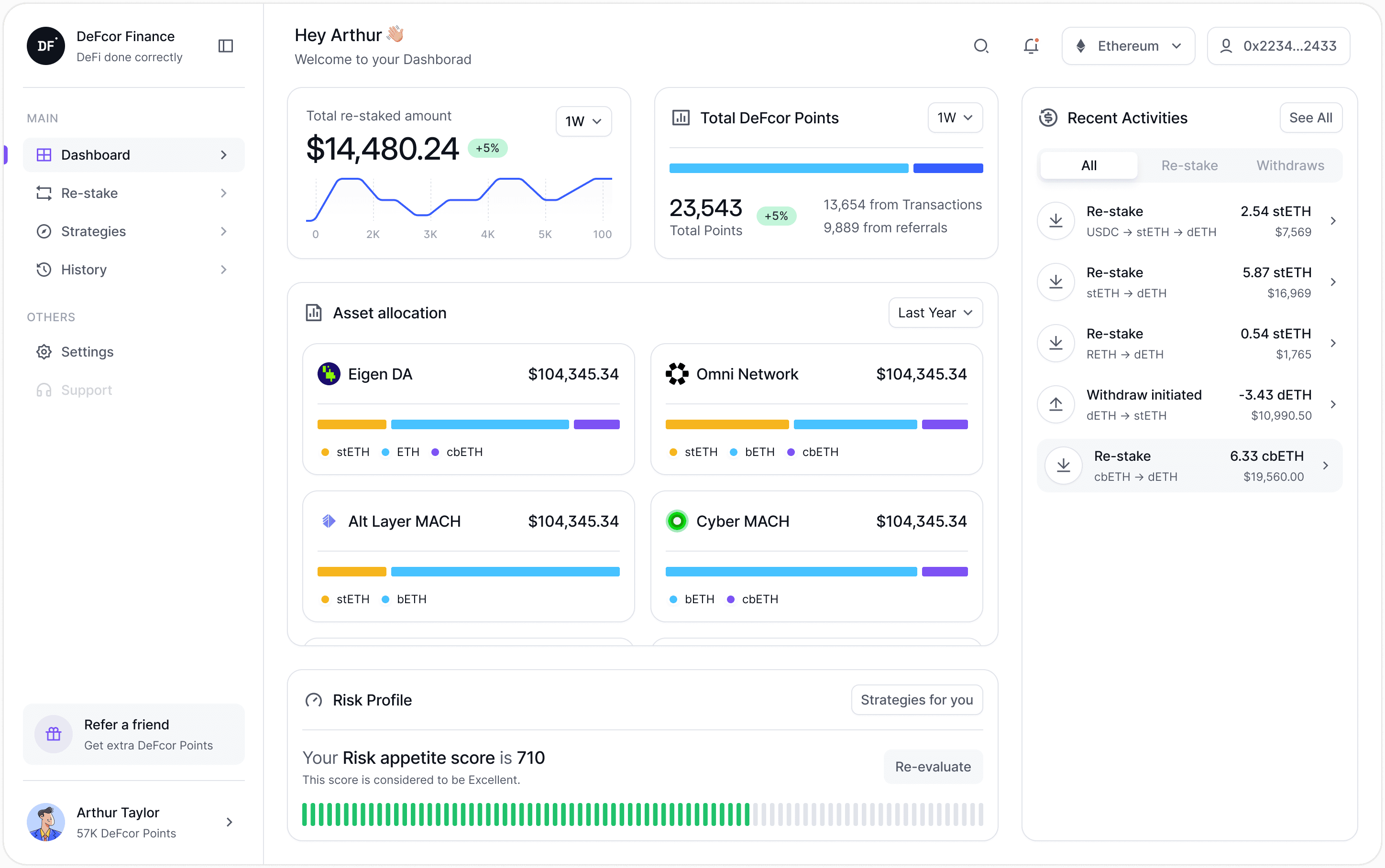
The Dashboard was designed to solve one big user need:
“I want to know what’s happening with my restaked ETH—without digging around.”
Instead of hiding insights behind tabs or toggles, we surfaced everything that matters in one scrollable view.
Modules Designed:
Total Re-staked Amount: Anchor metric with visual growth feedback.
DeFcor Points Tracker: Breakdown of how points were earned (referrals vs. restakes).
Asset Allocation: AVS-specific breakdowns (e.g. Cyber MACH, Omni Network), visualized with token-colored bars.
Risk Appetite Score: Helps users understand their exposure level.
Recent Activities: Quick log of actions with live status and explorer links.
Key UX Thinking:
Consistent data display formats across cards (USD, ETH, token icons).
Color-coded tokens for quick AVS association.
Time filters (1W, 1M, 1Y) that affect charts and point tracking for dynamic analysis.
Why it matters:
Restakers—from casual to advanced—get a real-time, high-trust view of their performance, allocation, and risk.
Re-stake Flow: Turning Complexity Into Confidence
One of the biggest challenges in DeFi design is guiding users through high-stakes flows—like converting ETH into an LRT—without overwhelming or confusing them. Most platforms hide risk, skip important context, or bombard users with technical jargon.
For DeFcor, I redesigned the Re-stake flow from the ground up to be:
Linear but flexible
Transparent but not overwhelming
Trust-building at every step
What Problems we solved
No Control or Choice in Restaking ?
Users don’t just deposit into a black box. They choose exactly which AVS they want to support through a modular strategy picker embedded into the Re-stake flow.
No Visibility Into Risk?
Key risk signals like APY, slashing score, operator count, and DeFcor Point multipliers are surfaced inline—not buried. This helps users compare strategies confidently before confirming.
Fragile, All-or-Nothing Token Design?
Solution: By letting users stake directly into chosen AVSs (vs. one pooled LRT), DeFcor reduces dependency on centralized decision-making—and lets users build diverse, balanced positions.
Complex UX That Deters Users ?
The flow is stripped down to 3 clear steps
Choose strategy + token
Enter amount
Confirm restake with visible reward + risk summary
Everything is reinforced with live balances, conversion estimates, and contextual tips.
Explore Strategies: Giving Restakers Real Choice
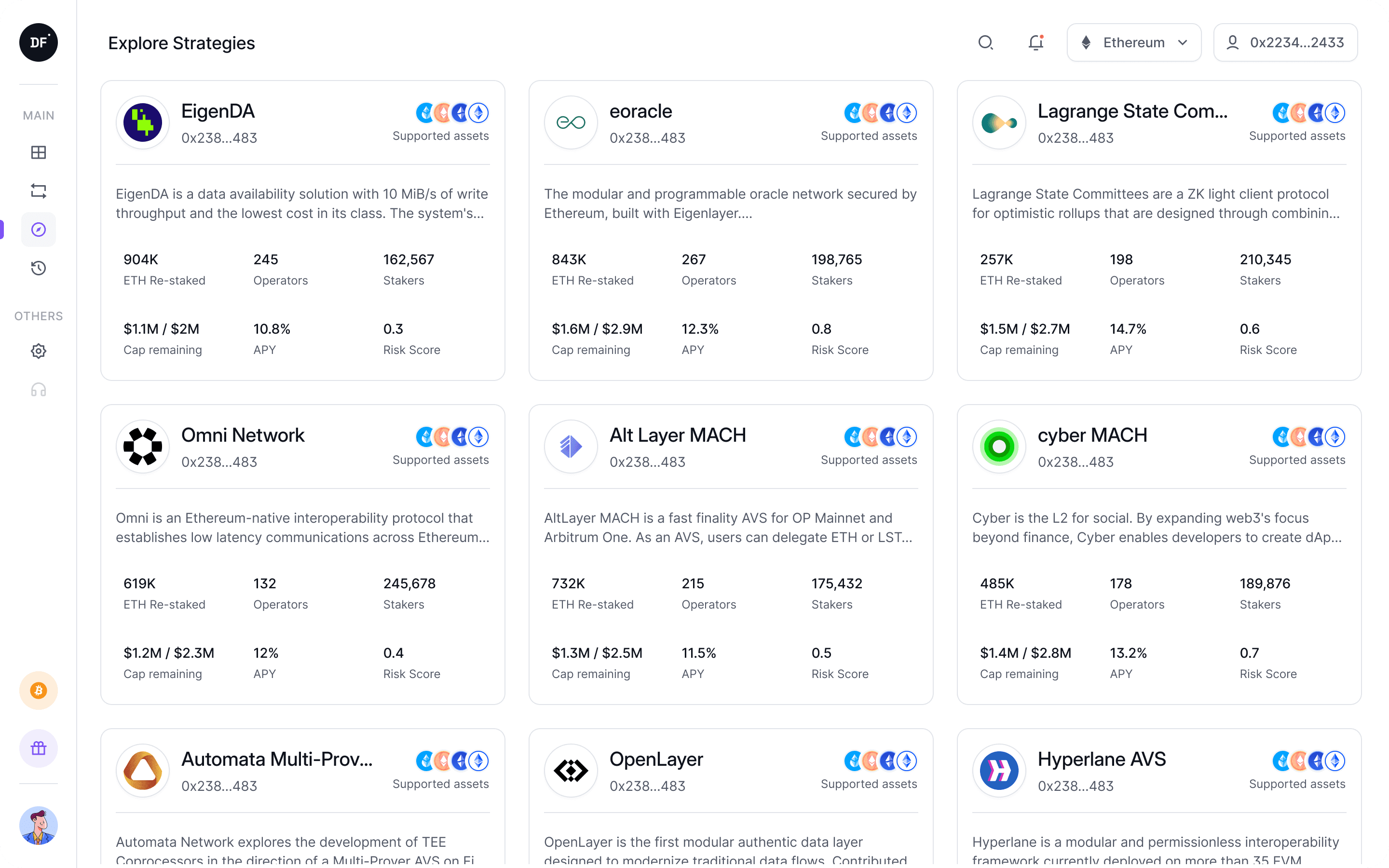
Most platforms hide where your ETH actually goes. With DeFcor, we made AVS selection transparent and actionable.
Instead of a single default strategy, users can browse a curated list of AVS pools—each with its own APY, risk score, validator count, and token support.
Solving Key Problems:
No control → Users choose exactly which AVSs to support, not the protocol.
No risk visibility → Each strategy card surfaces critical metrics for confident decision-making.
Design Highlights:
Card layout for quick scanning
Token badges for clarity
This gives both retail and institutional users the control they’ve been missing—before they ever click “Restake.”
Strategy Detail: Transparency Before Commitment
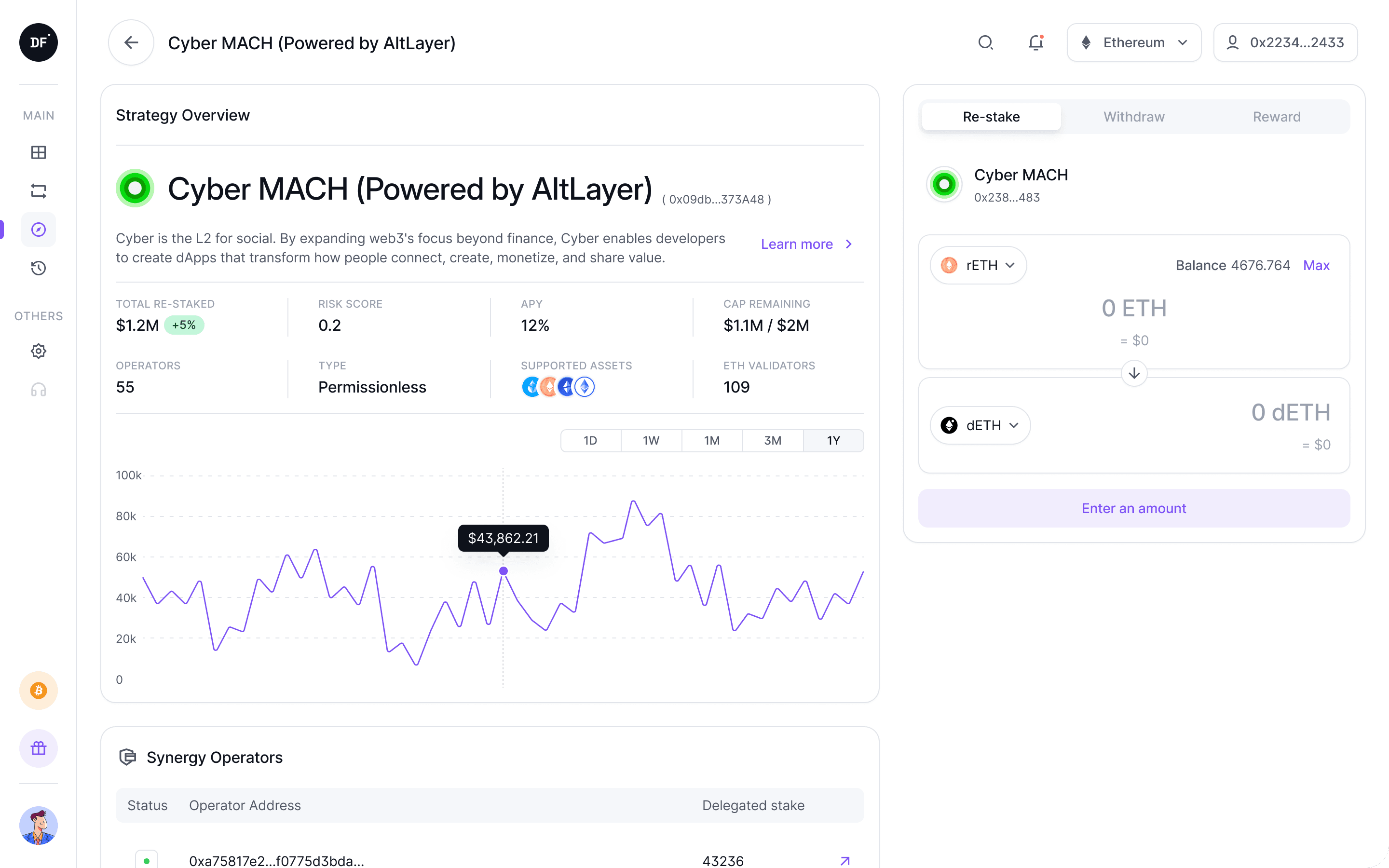
Most users never get to see what’s behind an AVS—just a name and an APY. With DeFcor, we turned each strategy into a transparent, data-rich page that helps users evaluate risk before restaking. Again, keeping the two main problems in mind—lack of visibility and lack of control—this page was designed to surface key metrics and allow direct action without switching context.
Design Highlights:
Visualized growth & staking activity
Key metrics structured for quick scanning
Permissionless vs. permissioned status clearly shown
This isn’t just a detail page—it’s a decision-support tool built for informed, high-stakes actions.
Transaction History: Clarity After Action
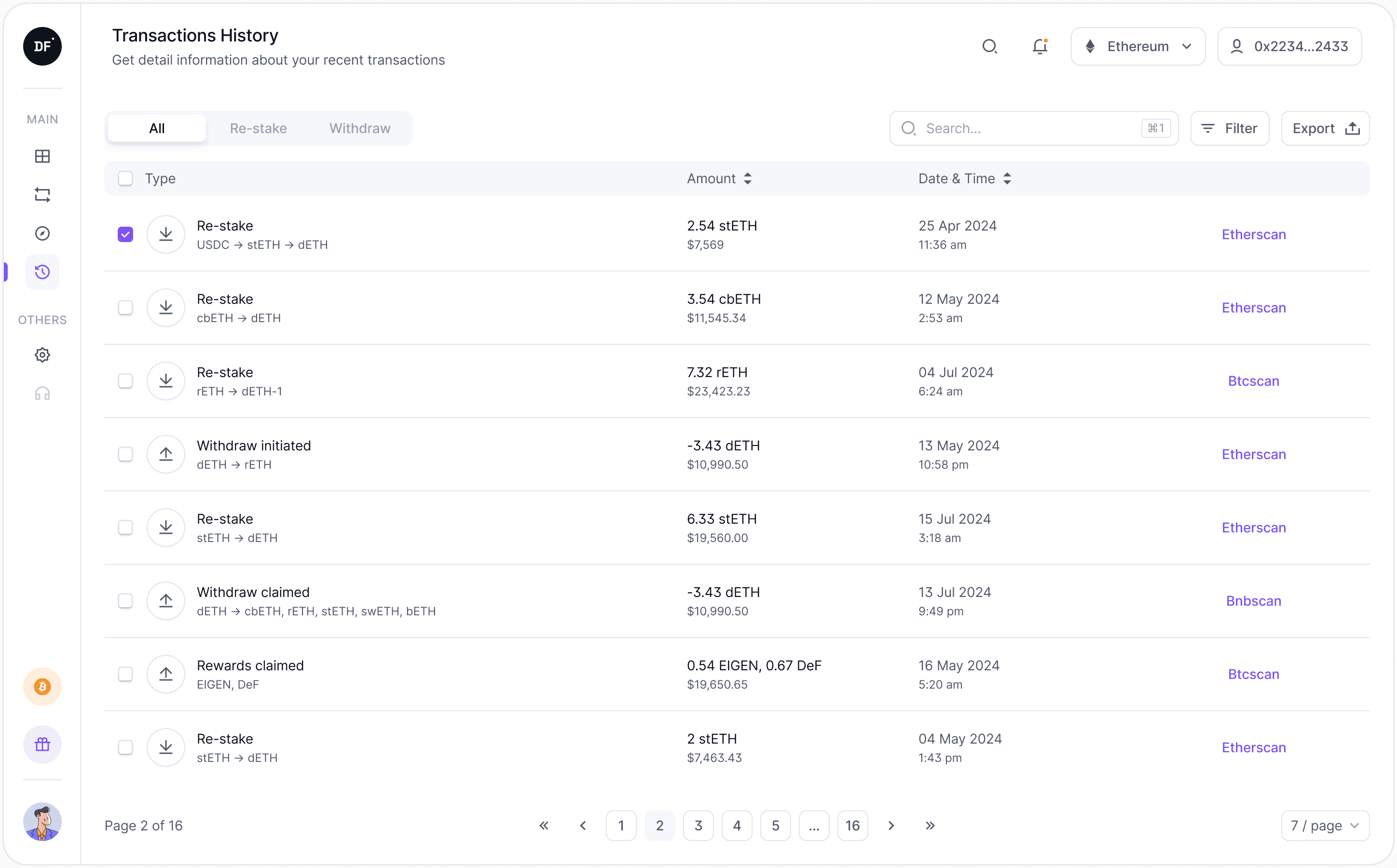
Post-transaction UX in DeFi is often messy—users are left guessing whether their actions went through, where to verify them, or how to find past activity. We kept the last problem in mind—complex, unclear UX—and designed a clean, sortable, and scannable transaction history.
Design Highlights:
Clear breakdowns of type, amount, and timestamp
Integrated scan links (Etherscan, Btcscan, etc.)
Filters by action type (restake, withdraw, rewards)
Pagination + search for scale-ready UX
Whether a user is staking $50 or $500K, this page makes every action trackable and trustable.
Outcome & Business Impact
DeFcor’s redesign wasn’t just about cleaner visuals—it was about solving real product issues with clarity, transparency, and user control. By tackling the most pressing gaps in restaking UX, the final product helped the team achieve key outcomes:
What Improved
Increased demo confidence
Product and growth teams used the dashboard and strategy flows in early investor demos—making complex mechanics easy to walk through.
De-risked institutional conversations
Clear AVS-level transparency, risk scores, and direct staking options made the product more credible to institutions and sophisticated users.
Reduced ambiguity for users and devs
Well-documented flows, clean IA, and consistent UI logic helped streamline both onboarding and development cycles.
This project wasn’t about fancy UI—it was about making restaking feel clear, intentional, and trustworthy, even in a fragmented DeFi ecosystem.
Reflection & Learnings
Designing DeFcor pushed me to think beyond interface aesthetics and focus on product clarity in a high-stakes, high-friction environment.
Here’s what I took away :
Designing for trust means showing your logic
Instead of hiding complexity, we surfaced just enough context (risk, AVS data, strategy stats) to let users feel in control—especially important in DeFi where most systems feel opaque.
Clear IA beats clever UI
The biggest UX wins came not from micro-interactions, but from making sure the information architecture supported real decision-making. Every section had a purpose, every screen supported a job to be done.
Workflows > Screens
What mattered most wasn’t how a screen looked in isolation—but how seamlessly a user could go from exploration → evaluation → action → confirmation. That meant aligning flows, edge cases, and dev clarity early.
This project helped me sharpen how I think about product design—not as a sequence of pretty screens, but as a system that builds confidence through every interaction.
Closing notes
If you’ve made it this far—thank you for taking the time to read through my case study. I’ve poured a lot of thought, effort, and care into this work, and I hope it gave you a glimpse into how I approach product design when it truly matters.

Akash Singh
Product designer
Check other works